


I was a kid who wanted magic to be real.
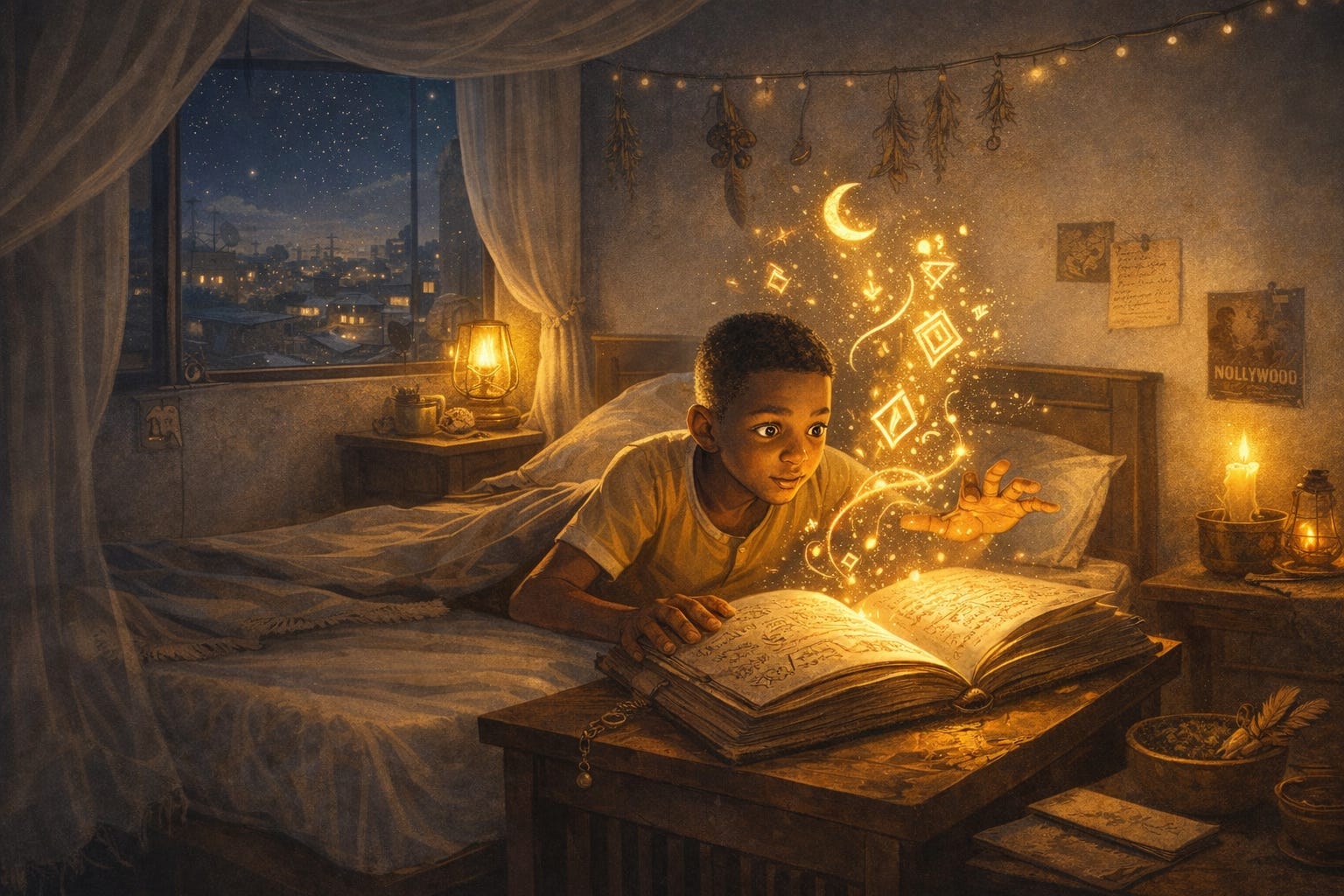
Not the magic of stage tricks, not cheap sleights of hand, not the fear stories of “juju” whispered in Lagos compounds and Nollywood scripts. I wanted real magic - the kind that shifts matter, moves minds, or lets one see what others cannot. I wondered: Can people truly fly, read minds, bend reality with thought? The stories passed down from our ancestors said it existed. Fairy tales across our cultures promised it. But everyday life told me no. At least, not in any way that my young eyes could verify.
If miracles were real, why were they hidden behind curtains? In church, prophecy was divine. Outside it, similar acts were called black magic. For a twelve-year-old in Lagos, this was a split reality — two worlds occupying the same city, the same family, sometimes the same sentence.
Then came along school, Western science. Newton’s laws, Einstein’s universe, the precision of chemistry, the logic of biology. Here was a method that said: repeat this experiment, and the outcome will happen again. Flying machines, healing technologies, communication networks, but these weren’t miracles. They were repeatable phenomena that obeyed patterns and reason. Not so different from magic, but explainable, verifiable, and open to anyone willing to ask.
Science welcomed questions without penalty. So it became my doorway. But I quickly found it was not the whole house.
The deeper I went, the more I noticed what science had quietly set aside. The elders in my community spoke of things that didn’t fit the syllabus — knowledge that predated the classroom, ways of engaging the world that no textbook acknowledged. Our ancestors moved through reality with a kind of confidence that modern education taught us to distrust. They consulted oracles. They read patterns in nature. They built civilisations on principles that Western science is only now beginning to gesture toward.
Somewhere between the colonial project and the modern classroom, we were taught to be embarrassed by it all. Taught not to get near it.
The question I carry now is no longer “Is magic real?” It’s this: if something was there, what did we lose? Who decided we should lose it? And what might we recover if we looked back, not with nostalgia, but with the same rigour and curiosity we were taught to reserve only for what came from elsewhere?
Intelligence Is Not — and Never Was — Only Human
In school, intelligence was treated like the holy grail, the highest prize in the human economy. The smart kid was a champion. They became doctors, engineers, leaders, the ones society lauded as architects of progress. But outside the classroom, another form of knowing was whispered: native intelligence. My parents used that phrase to describe something elders possessed — a kind of pattern-sense from life.
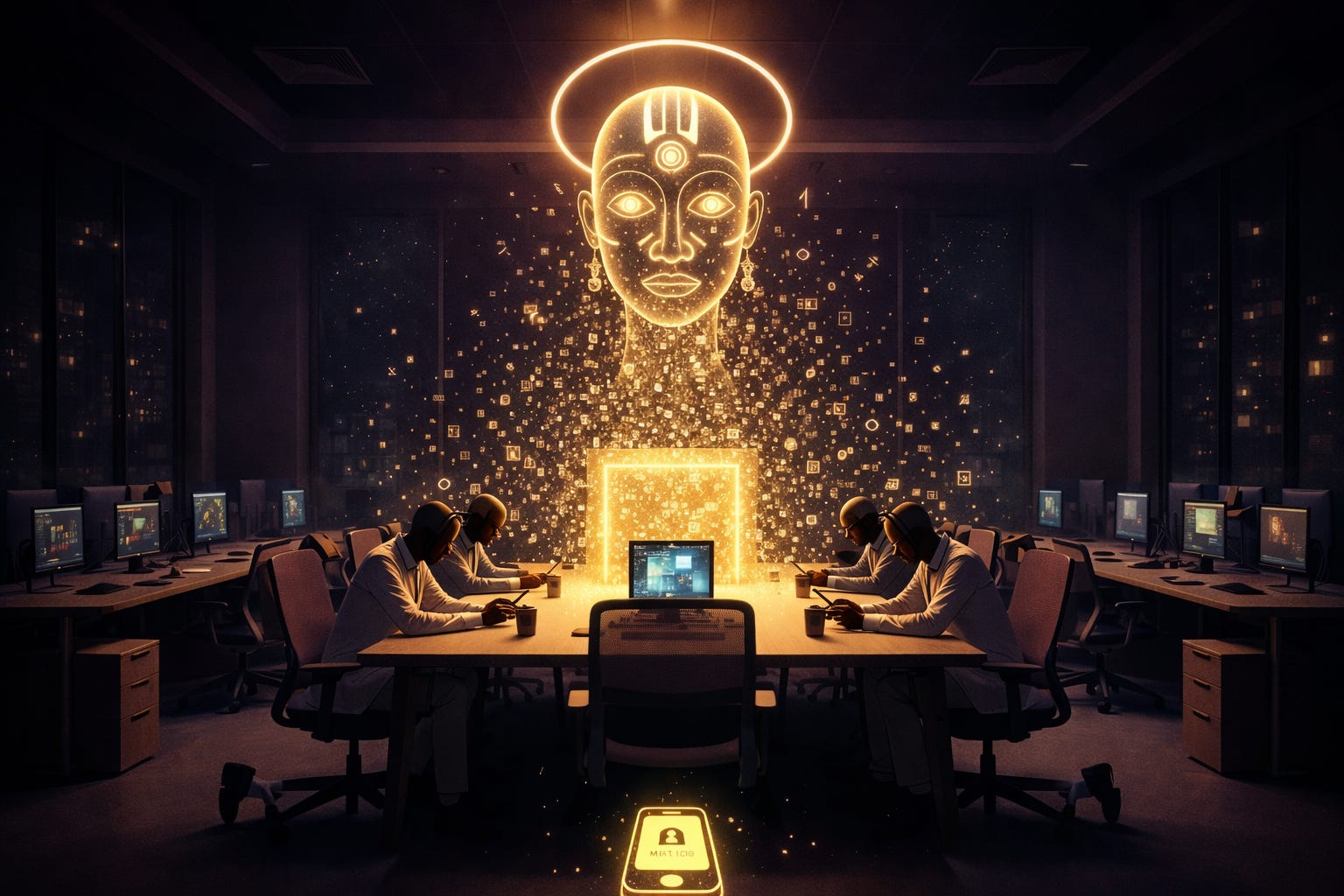
Then there was street intelligence, how I learned to read rooms in Surulere, Palmgroove, Yaba, Ikoyi, Victoria Island, Ile-Ife, Accra, London, New York. How to sense power before it spoke, how to move without being moved. These weren’t subjects on the syllabus, but they shaped real outcomes in my day-to-day life.
The lesson came slowly: intelligence is not only one thing, and it does not belong to us alone.
Consider what is happening inside your body right now, as you read this. Roughly 37 trillion cells are coordinating without your permission. Your immune system is identifying threats you will never consciously register. Your heart has been beating since before you had a thought, and it has never once asked for your input. There is an intelligence running you that has nothing to do with your mind, your degrees, or your decisions.
And it doesn’t stop at the boundary of your skin.
Beneath the floor of many forests in our indigenous West Africa, mycelial networks — vast webs of fungi — connect trees to one another, distributing nutrients from those with surplus to those in need. Scientists now call this the “wood wide web.” The trees communicate! They share. They respond to each other’s distress. No brain. No language. No intention as we understand it. And yet intelligence is evident.
Growing up, termites were a common feature, and their mounds achieved ventilation systems so precise. The mounds regulate temperature, humidity, and airflow through a structural design that no individual termite could have planned. The intelligence is in the system — emergent, collective, and far older than any human institution. Yet encoded in termites from one generation to the next.
In the skies, thousands of starlings move as one body in murmurations — no leader, no signal, just pattern responding to pattern in real time. In the ocean, octopuses solve problems with a nervous system distributed across eight arms, each capable of independent decision-making. Rivers across the planet find the most efficient path to the sea without a map.
What all of these point to is a simple but uncomfortable truth…
Intelligence is pattern recognition. It is an adaptation. It is a response. And it is everywhere; in the cells that compose us, in the ecosystems that surround us, in the planetary systems that carry us. We are not the source of intelligence. We are one of its expressions.
And yet, modern Western science has tended to place us above all of this as though consciousness appeared suddenly with the human brain and nowhere else, and we rarely question this. We built an entire civilisation on the idea that we are the thinking species and that everything else is a mechanism, a resource, or a backdrop. This belief has allowed us to build jets, satellites and digital networks. It also blinded us to the continuity of intelligence in the world around us and within us
The universe does not wait for our awareness to operate. It was intelligent long before we arrived, and it will be long after we are gone. The question is whether we are paying attention.
Language — The First Machine
I think in English. Yes, I am Yoruba by heritage, but my parents chose English for us early, believing it would be advantageous. They spoke in our native tongues at home, but English became the language of my thinking. This shaped how I perceived the world. It also shaped what I could no longer access.
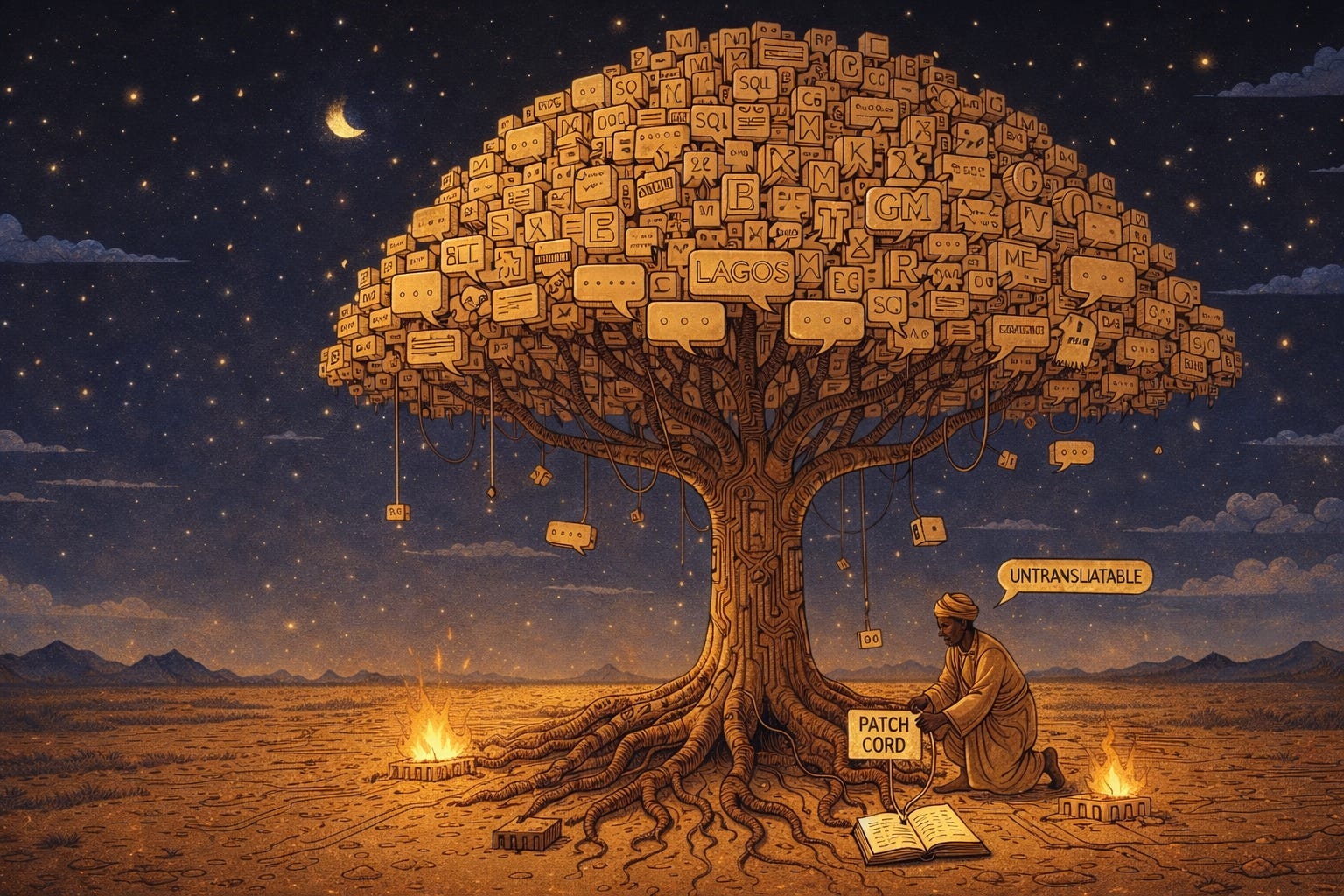
Language is technology. Not metaphorically, literally. It is the first tool that transformed consciousness into a shared reality. “And God said, ‘Let there be light,’ and there was light.” - Genesis 1:3
Before language, humans were limited. Research suggests that without shared symbolic communication, we could only maintain stable relationships in groups of around 150, the cognitive ceiling for social bonds held together by direct experience alone. Language broke that ceiling. It allowed us to coordinate with people we had never met, to plan beyond the immediate, to pass knowledge across generations without every lesson needing to be lived firsthand. Language turned collective memory into culture, and culture into civilisation.
The Tower of Babel story captures this strangely well: a unified language built a tower that was meant to reach heaven, and that same capability was fractured by the confusion of tongues. Humanity was scattered. But the power of language endured.
What the story doesn’t say, but history shows, is that the scattering was not only a loss. It was also localisation. As groups of humans spread across the earth, each community developed its own language in relation to its specific environment. The words, the tonal patterns, the idioms and the sounds weren’t arbitrary. They were shaped by landscape, climate, the behaviour of animals, the rhythms of local seasons, and the spiritual relationship each people developed with the land they called home.
In this way, language became more than communication. It became a carrier of indigenous intelligence, encoding the patterns of a people’s relationship with their world across centuries. The Yoruba language carries tonal subtleties that map meaning in ways English structurally cannot. The chants used by Ifá priests, the incantations of herbalists, the specific tonal sequences that call upon Orunmila are not ornamental but functional. They operate within a linguistic and spiritual architecture that was built in and for that language.
Can you chant to Orunmila in English? Can an incantation carry the same weight, the same precision, the same resonance when translated into a language that was never designed to hold it? This is a reality we rarely confront: that when a language dies, it does not simply take words with it. It takes an entire way of knowing. A technology of connection between people and their ancestors, between a community and the land, between the visible and the invisible, disappears.
Language doesn’t just describe reality. It constrains what a mind can notice.
And we have been losing these technologies steadily for generations. The colonial project did not just impose a new language. It displaced the intelligence systems encoded in the old ones. Many of us now think, dream, argue, and pray in English. We navigate the world through a linguistic structure that was built for a different context, a different cosmology, a different relationship with nature. The patterns of intelligence relevant to our environment, the ones our ancestors encoded in Yoruba, Edo, Igbo, Hausa, and hundreds of other languages, have been pushed to the margins of our own minds.
What does this erasure cost us? We may not fully know. But we should be asking.
Because now, a new form of language-based power is emerging. Large Language Models, the artificial intelligence systems reshaping how the world accesses and organises knowledge, are language made functionally operative at a scale we have never seen. They process, predict, and generate meaning from vast patterns of text. They look almost like what I once called magic. But they are built overwhelmingly on the languages and epistemologies that currently dominate the world.
AI will influence how billions of people think, learn, create, and make decisions. It is a new force, a new kind of energy entering human civilisation, and its patterns will ripple outward the same way the patterns of colonial language did before it.
Once language became mechanised, the rest was inevitable.
How much longer do we want to wait before asking what is being carried forward and what is being left behind?
Magic, Spiritual Technology, and Indigenous Knowing
In Yoruba cosmology, the spiritual realm is not separate from material reality; rather, it is its originating context. The visible world emerges from something deeper, and the relationship between the two is not metaphor but mechanics. Spiritual technologies were ways of interacting with this cosmological operating system: Ifá divination queries pattern alignment in Orun before acting in Aye; ancestors mediate memory and guidance between the realms; rituals synchronise conscious action with deeper forces of existence.
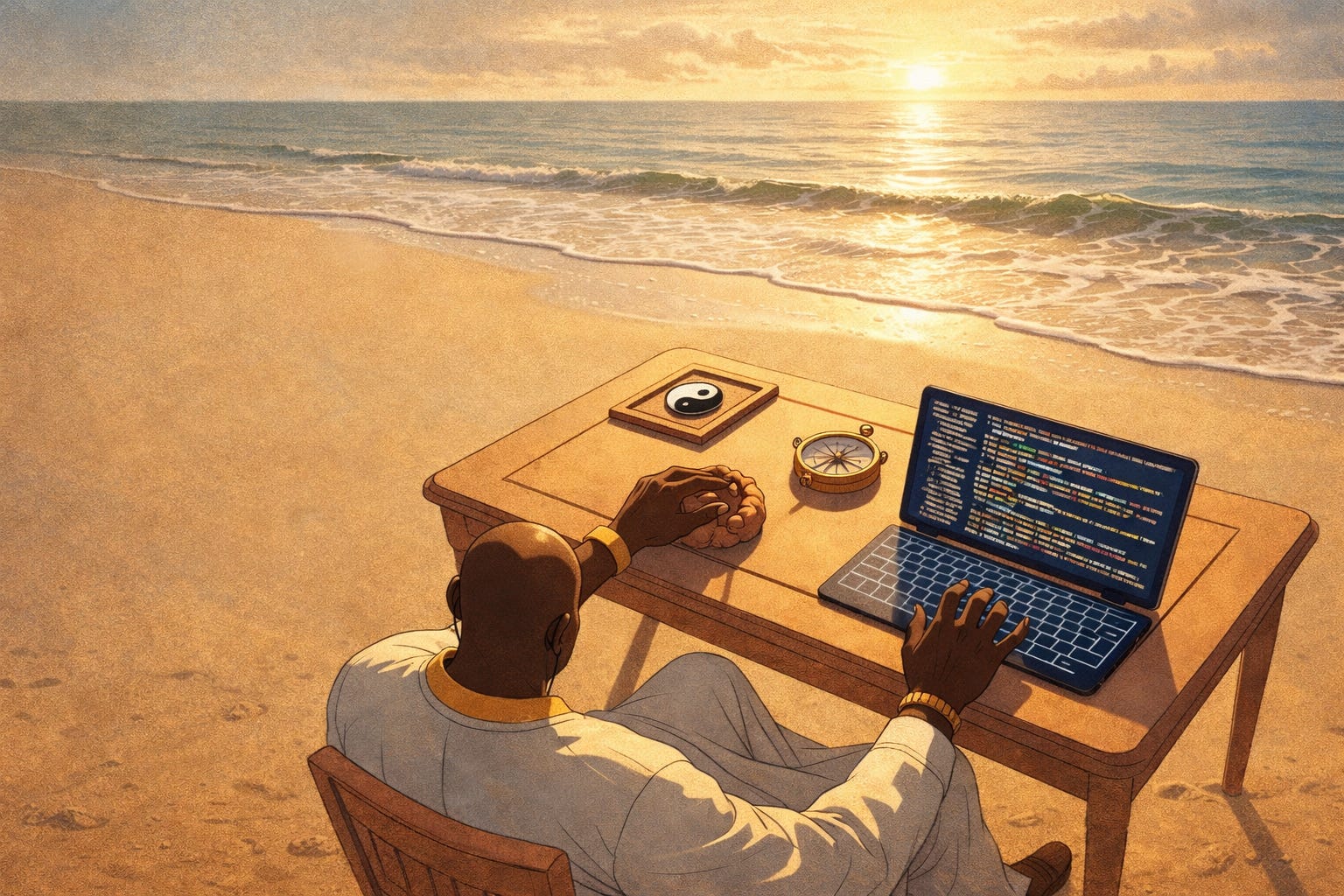
These were not passive beliefs but functional systems and methods for navigating reality. Our ancestors refined them across generations and passed them down with the same seriousness that any civilisation passes down what works. Perhaps the one big challenge is that they were passed down orally.
This is not unique to us; there are global parallels. Plato’s forms posited a realm of perfect patterns underlying the imperfect material world. Hindu cosmology speaks of lokas, planes of existence interpenetrating one another. Modern physics now hints at information fields beneath visible matter and at quantum entanglement, suggesting connections that transcend space. What many traditions call spirit, science increasingly calls information, field, or pattern. The language might differ, but the intuition that something underlies the visible world remains constant.
Yet because of colonial narratives and linguistic power, these indigenous technologies were cast as superstition, or worse, as something to fear. “Black magic.” “Juju.” “Primitive”. The complexity of systems we developed over centuries was reduced to caricature. As if they were inherently evil. Meanwhile, Western science, once a minority tradition itself, ridiculed by the Church, practised in secret, proclaimed universality. Its methods were presented not as one way of knowing, but as the only legitimate way.
I know this is uncomfortable terrain. It was designed to be.
The labels became a wall. Not a door to inquiry, but an ending. So we stopped asking what was actually there.
There’s something I’ve always been puzzled about: Science builds across generations. Newton stood on the shoulders of giants, and every generation since has stood on his. Knowledge accumulates because each generation inherits what the last one learned, tests it, refines it, and passes it forward. This is why humans are at the top of the food chain today, despite our humble beginnings. Our brains evolved, and we built systems that allowed us to compound progress across generations.
But with our own traditions, we often do not build. We start from zero, as if nothing useful existed before the Western framework arrived. We have not figured out how to codify, test, or understand which principles might still be relevant at scale. The label continues to close the door which very few dare to look behind.
The goal is not to romanticise the past. Every civilisation has its shadows, its cruelties, its errors, its practices that should rightly be left behind. But when scholars study ancient Greece, China or India, they do not reduce those traditions to their worst chapters. They examine philosophy, mathematics, medicine, and governance. They ask what was useful, and they build on that.
With our own knowledge systems, we have not extended the same curiosity. The question is, why?
What does it mean to lose connection to our contextual spiritual reality as indigenous people? And what might we recover if we approached our traditions not with shame or blind reverence, but with the same rigour and curiosity we were taught to reserve for what came from elsewhere?
Black Magic, the Golem, and Who Gets to Name Power
We stopped asking what was actually there because we were told it was dangerous. The label came first, and the fear followed.
The idea of “black magic” has mostly been placed on people of African descent as though the manipulation of unseen forces is something uniquely African, uniquely dangerous, uniquely evil.
Vodun. Nkisi figures. Charged objects. Rituals. These are often flattened into one crude category and dismissed. In Benin, Vodun is not a fringe practice or a sinister curiosity; it is a deeply rooted, formal, and complex religious system centred on nature, memory, and ancestral intelligence. In Nigeria, the Igbo tradition of dibia, healers and diviners who mediate between the physical and spiritual, served communities for centuries as counselors, physicians, and custodians of accumulated wisdom. These were not superstitions or chaos but structures for connecting past, present, and future.
The term black magic itself is a simplification and a weapon. A linguistic move. One that reveals how power operates through naming. What is framed as “science” in one culture becomes “sorcery” in another. What is “sacred technology” in one lineage becomes “darkness” in another.
But the label was not merely dismissive; it was strategic. If indigenous knowledge systems could be cast as dangerous and illegitimate, they could not compete with the frameworks being imposed. The label closed the door to inquiry, and over generations, it taught us to close it ourselves. We inherited the fear without questioning its origins. We learned to look away from what our ancestors looked toward.
The truth is, though, that these kinds of power and spiritual knowledge systems aren’t unique to Africa.
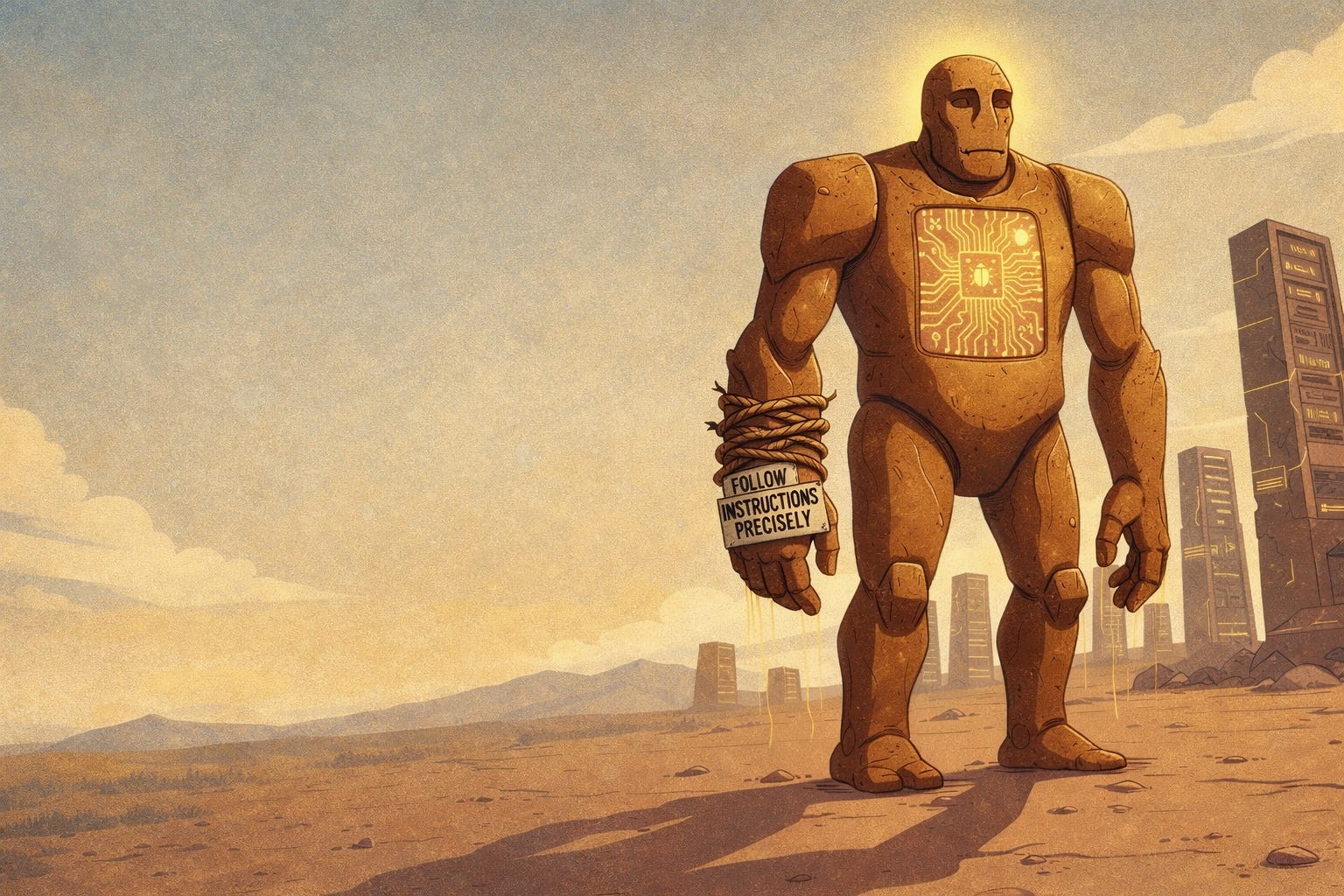
From Jewish mysticism, we find the Golem — a being formed from clay, animated by sacred language, brought to life through ritual inscription. The Golem could act. It could obey. It could perform tasks. But it could not reflect. It could not dream. It had power, but no wisdom.
Western alchemy sought to transmute matter through symbolic operations. Hermeticism taught, “as above, so below”, the principle that ritual action here could correspond to movements in higher realms. The Gospel of John opens with “In the beginning was the Word, and the Word was with God, and the Word was God”, language as the mechanism of creation itself. These traditions shared the same intuition: that words, symbols, and intention could interact with reality in operative ways.
These were studied, debated, and preserved. Ours were labelled and discarded.
In many ways, the Golem is one of humanity’s earliest metaphors for artificial intelligence. A constructed intelligence. Animated by language. Functional, but hollow. What’s interesting is not that the Golem existed as myth, but that its story survives as a warning. The danger was never the creation itself but the absence of restraint, context, and responsibility. Power without wisdom. Action without understanding.
When we dismiss African spiritual technologies as “black magic” while treating European metaphysical experiments as philosophy or proto-science, we are not being objective. We are telling a story about who is allowed to wield power and who must be feared when they do.
And that story has lasted longer than the people who first told it. It lives on in how we think, what we question, and what we refuse to examine. The storytellers are gone. But the story remains, shaping us still.
Egregores — Collective Mindforms and Invisible Architects
There is a concept in Western esotericism called the egregore: a collective thought-form, an entity generated by the sustained focus of a group. It sounds abstract until you see it everywhere.
A nation is an egregore. There is no physical thing you can point to and say, “This is Nigeria” or “This is France.” There are borders on maps, but borders are just lines people agreed to respect. There are flags, anthems, passports, symbols that mean nothing until enough people believe they mean something. Yet nations go to war. People die for them. People kill for them. The belief becomes more real than the believers.
A corporation is an egregore. It has no body, no soul, no conscience. It is a legal fiction, a pattern of agreements, incentives, and behaviours that persists even as every human within it is replaced. The company can outlive its founders, sue people, own property, and shape laws. It acts in the world as if it were alive.
If you have ever built a company, organisation, or brand that took on an identity larger than you, you have helped create an egregore. And once formed, these thought-forms take on a life of their own, detached from any single creator, shaping cultures, systems, and destinies long after their originators are gone.
Here is what I find myself sitting with: how much of the egregores that govern our lives are of our own making?
The borders that define African nations were drawn in Berlin in 1884 by people who never walked our soil. The economic systems we participate in were designed for extraction, not prosperity, at least not ours. The religions many of us practice arrived with colonial ships, carrying cosmologies rooted in other lands, other histories, other relationships with the divine. Even the languages we think in, as we discussed, shape what we can conceive.
We are vessels for these thought-forms. They move through us, through our ambitions, our fears, our definitions of success and failure. And most of the time, we do not notice. The egregore does not announce itself. It simply feels like “the way things are.” The storytellers might be gone. But the stories they told persisted and continue to shape what we believe is possible, what we think is respectable, and what we consider real.
The question is not whether we can live without the influence of these thought forms. Humans are collective creatures; we will always generate shared beliefs that take on lives of their own. The question is whether we are conscious participants or unconscious carriers. And whether the egregores we serve were ever designed for our flourishing or for someone else’s.
From Ancient Tech to AI — What’s Really New?
When people talk about artificial intelligence today, it’s often framed as something unprecedented — a rupture. A moment where intelligence suddenly escaped the human body and took on a life of its own.
This is a misconception. We are not seeing the birth of intelligence, but its latest container.
Humans have always externalised intelligence. First into language. Then into stories. Then into symbols, rituals, institutions, machines. AI is different in scale and speed, but not in essence. It recognises patterns. It predicts. It recombines. It does what intelligence has always done, just faster, and without a body.
Which brings us back to the Golem.
A system animated by language. Capable, tireless, obedient but fundamentally unwise. They followed instructions. They could not ask whether the instructions were good. They could not weigh consequences across generations. They could not feel what it meant to be human. And in many versions of the story, this is precisely what made them dangerous.
That is the real tension of this moment. Not whether machines will become intelligent, they already are, in their own way. The question is whether intelligence without lineage, memory, or consequence can ever become wise.
And there is a deeper question still, one that touches those of us on this continent directly.
Nigeria will be home to over 400 million people by 2050, making it the third most populous nation on Earth. Sixty-three per cent of us are already under twenty-five. Africa accounts for 18% of the world’s population, yet less than 1% of global data centre capacity. We are 2% of the world’s computing infrastructure. We are building the future with tools that were not built for us, trained on languages and epistemologies that often do not include us, and designed to serve interests that may not align with ours.
This is not a new pattern. Our ancestors faced something similar, external forces arriving with technologies and systems that reshaped everything. Some communities collaborated. Some resisted. Many were simply overwhelmed before they understood what was happening. The merchants came first. Then the missionaries. Then the administrators. Each wave carried its own logic, its own egregore, and by the time the pattern was visible, it had already taken root.
Today, the forces are less visible. They are encoded in algorithms, in platforms, in the economic structures that determine what gets funded and what gets forgotten. And the pace is faster. We do not have generations to figure this out. We may not have decades.
I am not saying AI is purely a threat. It is not. It is also a possibility, the possibility of learning at scale, of preserving what remains of our languages and knowledge systems, of building tools that actually serve our contexts. But possibility only becomes reality when you are a conscious participant in shaping it. And right now, most of us are not participants. We are users. We are data. We are downstream.
The question that sits with me is this: will we recognise the pattern this time? Will we understand that the game has changed, that collaboration, at scale, across our differences, is no longer optional but existential? Or will we remain fragmented, focused on the local while global forces reshape the ground beneath us?
Our ancestors who stayed within their communities, tending their own affairs, were not foolish. They were doing what humans have always done. But they were also unprepared for what arrived. And what arrived did not wait for them to be ready.
Neither will this.
Wisdom — The Ancient Work That Still Matters
Our ancestors — Africans, Asians, Indigenous peoples, mystics, sages — were not oblivious to technology. They simply engaged it differently. They understood that tools without direction become weapons, that knowledge without context becomes noise, and that power without responsibility becomes ruin.
This was not ignorance of progress. It was a different kind of intelligence, one that asked not only “what can we build?” but “what should we build, and why, and for whom?”
Today, as AI evolves and creates languages humans struggle to interpret, the concept of intelligence itself must be rethought. We will soon need to differentiate between capacity to compute and capacity to care; between speed of learning and depth of understanding, between pattern recognition and genuine knowing.
Intelligence was never the missing ingredient. We have more of it now than at any point in human history, distributed across servers, encoded in models, accessible at scale. And yet, the fractures widen, and the noise grows louder while the signal fades.
The real crisis is a lack of wisdom; the capacity to align action with deeper insight, consequence, and care. Wisdom is what knows when not to act. Wisdom is what holds the long view when everything demands the immediate. Wisdom is what remembers that we are not the first to face this, and we will not be the last.
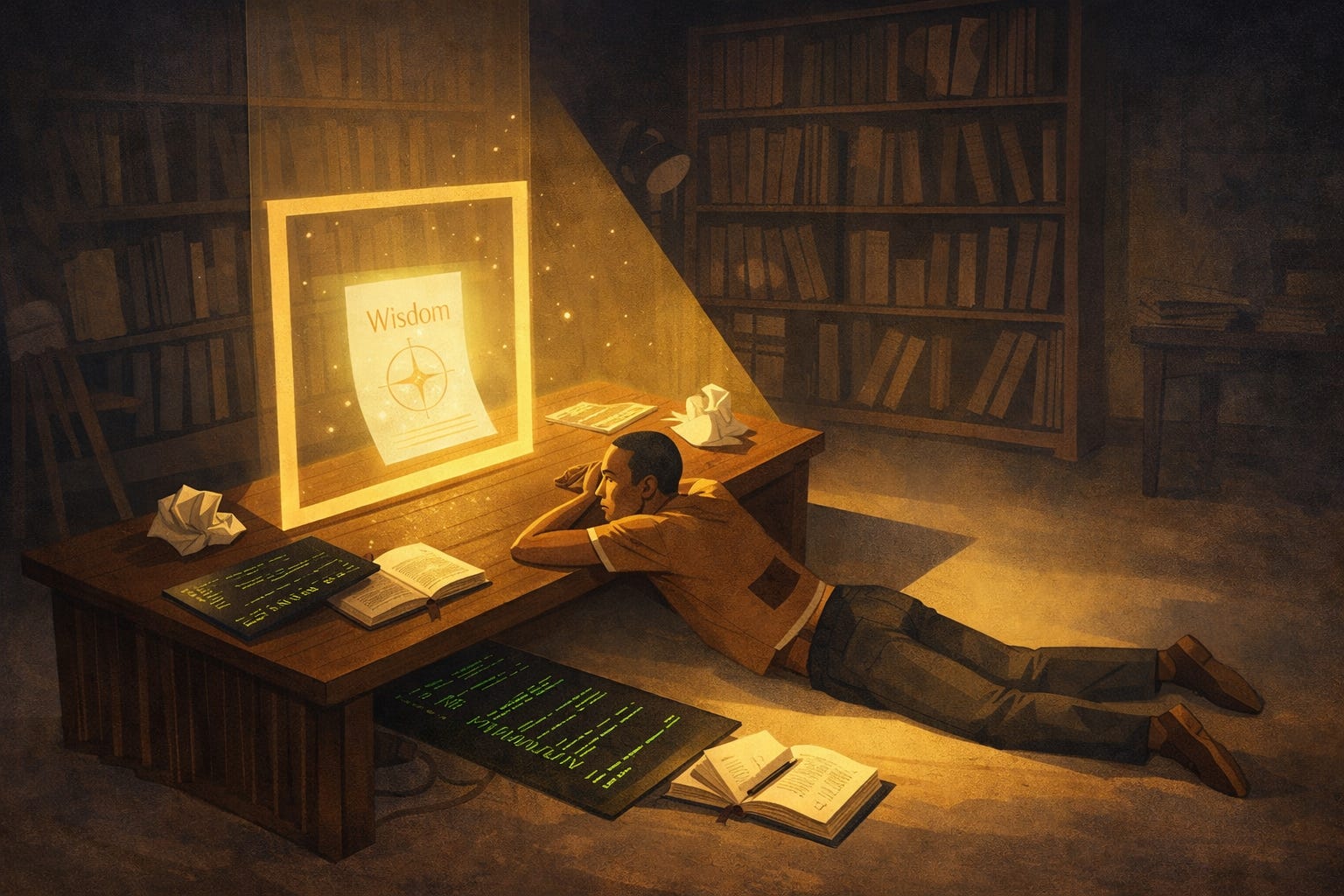
We look inward and backwards not to escape modernity, but to recover what modernity forgot to carry forward. We look to ancestors not for dogma, but for orientation, to see what they saw, to ask what they asked, and to adapt it to our age. Not every answer they found will serve us. But many of the questions they asked are the same ones we now face, dressed in a new language.
If we engage wisely, the same tools that threaten to deepen our disconnection could become instruments of reconnection. The same systems that risk erasing our languages could help preserve them. The same intelligence that was trained without us could be shaped by us if we choose to participate and bring something to the table beyond consumption.
That is the work ahead. Not rejection of the new, but integration of the old. Not nostalgia, but recovery. Not answers, but better questions. A call to adventure.
Because if intelligence alone built the machine age, then wisdom must build the age to come.
Ogbon + Ule exists to ask these questions publicly, rigorously, and without fear.
What questions did this raise for you? Reply or leave a comment. We read everything.
Love,
Wale & Mufasa.
Interesting read!
Fascinating, detailed deep dive.
There is so much food for thought in this write-up.
I'll be re-reading it a few more times, for sure.